Restoring Stability, Rebuilding Confidence: A Landfill Transformation
Date: Jun 01, 2026
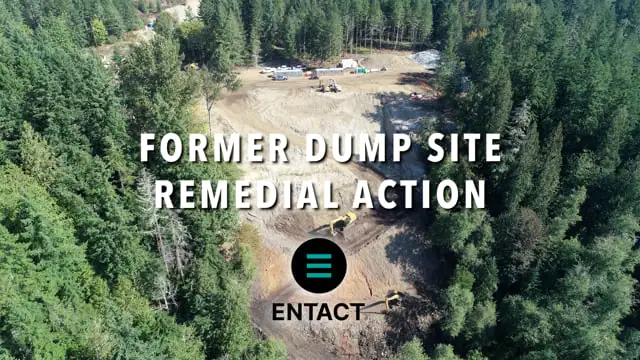
In the small West Coast community of Eatonville, this site had long been part of the landscape. Rising nearly 140 feet above the surrounding area, the former landfill presented both a visible presence and a technical challenge. The landfill had originally been developed by placing waste over the escarpment of an ancient landslide complex, where pre-existing instability and marginal factors of safety created inherent risk for any earthmoving or regrading activities.
With the site planned for restoration and incorporation into the surrounding park, addressing slope stability was critical to support its transition from a closed landfill to a safe landscape.
DESIGN-ASSIST-BUILD APPROACH FOR LANDFILL REMEDIATION
ENTACT entered the project with an approximately 50% design and, through an accelerated design-assist effort, mobilized to construction within six months.
Working collaboratively with the City of Eatonville, Weyerhaeuser (which owned the land and had leased it to the city), and GSI Water Solutions, Inc., ENTACT advanced the remaining design in parallel with preconstruction planning. This included completing the grading design, developing the switchback access approach required to safely work the steep slopes, and finalizing the soil nail wall design.
This accelerated timeline was critical to align construction with available state grant funding and to complete major earthwork activities ahead of the rainy season, when elevated groundwater and reduced soil strength would significantly increase slope instability risks. Sequencing, access, and stabilization were tightly integrated during this phase, allowing field conditions and constructability considerations to directly inform final design decisions and move the project efficiently into execution.
LARGE-SCALE LANDFILL EXCAVATION ON STEEP SLOPES
Work began on the landfill slopes, where grades exceeded 1H:1V and, in some locations, approached near-vertical conditions. ENTACT excavated and removed approximately 60,000 cubic yards of material using long-reach excavation equipment and tracked haul trucks operating along temporary switchback access roads constructed directly into the slope.
Waste limits extended deeper than originally anticipated in several areas, requiring additional excavation to fully remove impacted material. At the same time, a significant seep encountered within the mid-slope required active management and rerouting to maintain slope stability and keep work areas accessible.
Maintaining access under these conditions was a constant effort. Steep haul roads were frequently regraded and realigned as excavation progressed. Tracked haul trucks were utilized to navigate the grades and variable surface conditions, allowing operations to continue safely where conventional equipment would have been limited.
Excavation sequencing was carefully managed to limit surcharge and avoid overstressing already marginally stable areas, particularly near the landslide interface. Survey control and real-time grade verification guided each phase of work to achieve design geometry while minimizing disturbance to surrounding areas.
SLOPE STABILIZATION USING SOIL NAIL WALL SYSTEMS
At the landfill margin, a historic landslide area required stabilization. Given the limited footprint and the need to avoid adding load to an already sensitive slope, a soil nail wall system was selected over a conventional buttress approach, eliminating the need to excavate approximately 20,000 cubic yards of additional material.
ENTACT designed and managed construction of a 30-foot soil nail wall, with installation performed by a specialty subcontractor using self-drilling nails, shotcrete facing, and drainage elements. The self-drilling system allowed installation to proceed through loose and saturated materials where open holes would not stand.
Ground conditions varied along the alignment, requiring adjustments to nail lengths and installation as work progressed. Seepage encountered during excavation was incorporated into the wall drainage to reduce pore pressure and maintain stability. The finished shotcrete face was sculpted and textured to resemble a natural rock outcrop, allowing the structure to blend with the surrounding park landscape.
SITE RESTORATION AND WETLAND CONSTRUCTION
As stabilization was completed, the site transitioned into restoration. A key objective was addressing impacts to the wetland below the landfill.
The majority of waste material was removed, allowing the wetland area to be restored even beyond natural conditions. Using the Terrestrial Ecological Evaluation (TEE) process, the cleanup driven by Cleanup Levels (CULs) removed background concentrations and will be monitored moving forward to determine the overall success of the cleanup. A seep identified within the landfill slope was intercepted and rerouted to the base of the slope, where ENTACT designed and implemented a seep collection and conveyance system to provide a controlled water source to the restored wetland.
Additional restoration work included construction of permanent stormwater conveyance and energy dissipation features, riprap buttresses, topsoil placement, erosion control, hydroseeding, and native plantings. The project concluded with restored access roads, permanent security features, and final surveying and quality verification.
ENVIRONMENTAL REMEDIATION AND GEOTECHNICAL CONSTRUCTION RESULTS
What was once an area of concern is now a stabilized and restored site that supports the community around it.
As the Client shared:
“Your transparency regarding actual costs and understanding of funding limitations was particularly commendable. That honesty built trust early on, and what’s remarkable is that trust remained intact through project completion.”
Completed safely and within schedule, the project reflects the value of alignment, constructability, and real-time collaboration in delivering environmental remediation and geotechnical construction solutions that perform long after the work is done.
A timelapse video below captures that transformation from active construction to a fully restored landscape.
Related articles
ENTACT CELEBRATES 35 YEARS OF PERFORMANCE, PARTNERSHIP, AND PEOPLE
WESTMONT, Ill. – August 06, 2026 – ENTACT, a leading environmental remediation, geotechnical construction, and sediment remediation contractor, celebrates 35 years in business this month, recognizing the Associates, Clients, and Partners who have helped shape the company since its founding on August 13, 1991. Over the past three and a
Read full article
Ridgemont Equity Partners Acquires ENTACT
CHARLOTTE, N.C. – August 4, 2026 – Ridgemont Equity Partners (“Ridgemont”), a middle market private equity investor, today announced it has acquired ENTACT, LLC (“ENTACT” or the “Company”), a leading provider of environmental remediation and geotechnical services. The ENTACT management team will remain meaningful investors in the business and continue to
Read full article
ENTACT Associates Publish Peer-Reviewed Paper on Subaqueous ISS in Remediation Journal
A team of technical experts from ENTACT and GEI Consultants has published the peer-reviewed paper, State of the Practice – Sub-Aqueous In-Situ Solidification for Contaminated Sediment Remediation, in Remediation Journal. The publication synthesizes lessons learned from the planning, design, and construction of subaqueous in-situ solidification (ISS) remedies implemented across North
Read full article